
























 Featured
10.0
Independent & unsponsored · No ads, no tracking · verified every 6 hours
Published June 20, 2025 · Last updated 1 month ago
Trustless atomic swaps, zero KYC.
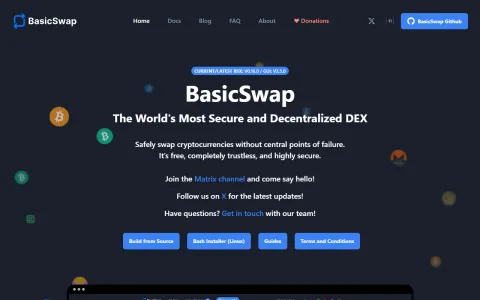
BasicSwap is a decentralized exchange (DEX) built for users who refuse to compromise on privacy or custody. Launched in 2022 and developed in proximity to the Particl ecosystem, it facilitates peer-to-peer cryptocurrency swaps through native atomic swap protocols-HTLC (hash time-locked contracts) and PTLC (adaptor signatures)-without wrapped assets, intermediary chains, or any central counterparty. As of 2026-05-30, the project runs protocol version 0.16.0 with GUI version 3.5.0, with v0.16.2 released in May 2026 per the official blog.
The exchange operates as downloadable software rather than a website-based platform. Users run the client locally, sync the relevant blockchains, and interact through a decentralized order book propagated over Particl's SecureMessaging Network (SMSG). There are no accounts, no registration emails, and no server holding user funds.
BasicSwap achieves the strongest possible no-KYC classification: KYC is technically impossible by design. The protocol has no centralized operator capable of collecting identity documents, no account system to link trades to personas, and no custodial wallet that could freeze funds. Swaps execute directly between users' own wallets via on-chain smart contracts; the BasicSwap contributors do not process, execute, or initiate transactions.
This architecture places it at KYC Level 0 (trustless) on standard privacy scales. The only "identifying" information exchanged is the cryptographic data necessary for atomic swaps-public keys, hashes, and adaptor signatures-none of which link to real-world identity.
Privacy on BasicSwap derives from its architectural choices rather than policy promises. The distributed order book and SMSG messaging layer mean no central server logs trade intentions or IP correlations. Users retain sole custody of private keys throughout the swap lifecycle.
The platform supports privacy-centric assets natively, including Monero (XMR), which uses ring signatures and stealth addresses, and Litecoin's MWEB extension for confidential transactions. Bitcoin swaps occur on-chain without address reuse requirements.
Security-wise, the atomic swap protocols are well-established open-source standards developed by the broader cryptocurrency community, not proprietary BasicSwap code. The May 2026 blog post highlighted architectural differences that prevent the fake-ACK exploit that affected RetoSwap, suggesting active security awareness. However, no independent security audit specifically covering BasicSwap code was found in the evidence; Particl platform reviews exist but do not directly audit this DEX implementation.
BasicSwap charges zero trading fees. The only costs are the native blockchain transaction fees of the coins being swapped. There are no deposit fees, withdrawal fees, or spread premiums collected by the protocol.
Supported cryptocurrencies as of the latest crawl include:
There is no fiat on-ramp or off-ramp; all trades are crypto-to-crypto. No minimum or maximum deposit limits exist, though practical liquidity constraints apply based on what other users have posted to the order book.
BasicSwap requires meaningful technical commitment. Users must build from source or run installers (.EXE for Windows, Bash for Linux), sync multiple blockchain clients, and wait for full synchronization before trading. The Wallets page tracks sync progress. Documentation exists for placing offers, taking offers, and monitoring swap progress through BID IDs.
Community support channels include Matrix, X (Twitter), and Discord/Telegram per third-party reviews. The Reddit community is small and operates with restricted posting. No dedicated customer service department exists-appropriate for a decentralized project, but a friction point for non-technical users.
A notable 2026 development is the upcoming integration with Litecoin's Nexus mobile wallet, which would represent BasicSwap's first mobile accessibility.
BasicSwap suits privacy-maximalists, Monero enthusiasts, and technically proficient traders who prioritize custody and censorship resistance over convenience. It solves the BTC↔XMR swap problem without trusting custodial bridges or centralized exchanges. Users comfortable running Bitcoin Core, Monero wallets, and waiting for block confirmations will find the trade-off acceptable. Those seeking one-click trading, fiat access, or customer support should look elsewhere.
Compared to custodial no-KYC exchanges, BasicSwap eliminates counterparty risk entirely at the cost of liquidity and operational complexity. Compared to other DEXs, its native atomic swap approach avoids smart contract vulnerabilities on secondary chains but requires more local infrastructure.
No account required at all.
BasicSwap collects no personal data by protocol design-no accounts, no emails, no IP logging by a central server. The SMSG messaging layer is decentralized and open-source. Users should note that on-chain atomic swaps produce public blockchain records; while no KYC links identities to addresses, chain analysis of transparent ledgers (Bitcoin, Litecoin non-MWEB) remains possible. Monero swaps inherit XMR's ring signature privacy.
No
Custodial
No
Requires email
No
Logs IP
Verdict
BasicSwap is the right tool for privacy-conscious users who accept technical overhead in exchange for eliminating trust assumptions. It outperforms custodial alternatives on sovereignty but trails on convenience and liquidity. Ideal for intermittent, high-priority swaps between Bitcoin and Monero rather than active trading.
This review is monitored and refreshed regularly.
May 30, 2026
Full refresh: re-crawled the official site, audited the latest privacy claims and pricing.
May 14, 2026
Added v0.16.2 release note and RetoSwap exploit architectural comparison from May 2026 blog.
March 8, 2026
Noted upcoming Litecoin Nexus mobile wallet integration for expanded accessibility.
October 20, 2025
Updated supported coins list and zero-fee structure from current terms and FAQ.
June 20, 2025
Initial review published.
9 user reviews
moneromaxi
finally a dex that actually delivers on the no-kyc promise. running my own node feels right, btc to xmr worked clean.
anon_trader
took forever to sync but once running the swap was smooth. liquidity is thin though, had to wait for a taker.
privacyfirst
the only way to trade xmr without trusting anyone. no accounts, no emails, no bs. exactly what crypto should be.
xmr_only
great concept but the ux is rough. had to troubleshoot wallet connections for an hour. not for casual users.
sat_stacker
zero fees are real, only paid btc network fee. order book was sparse for ltc pairs but btc/xmr had some action.
cypher_punk
open source, atomic swaps, no kyc possible by design. this is the standard all dexes should be held to.
liquidity_hunter
tried three times to find a match for my trade. ended up using a custodial swap instead. great privacy, poor volume.
particl_fan
smsg network is solid, no central server to seize. gui has improved a lot since early versions but still desktop only.
newbie_kyc_refugee
couldn't figure out the install. no support ticket system, matrix chat was slow. went back to a simple exchange.