
























 Featured
8.0
Independent & unsponsored · No ads, no tracking · verified every 6 hours
Published April 27, 2025 · Last updated 1 month ago
No-KYC virtual cards, KYC-required physical option.
BingCard is a crypto debit card provider founded in December 2021 and launched publicly in December 2022, incorporated under Canadian law according to its Terms of Service. The platform offers two product lines: virtual cards for online spending and a physical card for in-person use. As of 2026-05-30, the service markets itself heavily toward privacy-conscious users seeking quick access to crypto-backed payment methods without traditional banking friction.
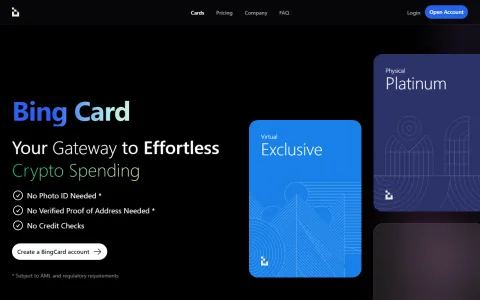
BingCard operates a split KYC model that demands careful attention. The two virtual card tiers-Exclusive and Star-are issued without KYC according to the FAQ and product pages, with the homepage stating "No Photo ID Needed" and "No Verified Proof of Address Needed" for virtual products. However, the physical Platinum card requires online KYC completion. The asterisk on the homepage noting "Subject to AML and regulatory requirements" creates meaningful ambiguity about when and how the no-KYC policy might be overridden. This is not a fully KYC-free service-it is a selectively no-KYC service where the privacy guarantee depends entirely on product choice.
The privacy picture is mixed. Virtual cards require only an email and password to start, but the Privacy Policy (last updated April 19, 2023) indicates broad data collection rights and compliance with both US federal/state regulations and EU GDPR. The Terms of Service warn that users "take all risks and responsibility for holding and dealing in Virtual Currency." No independent security audit results or bug bounty programs were found in the evidence. The company claims to act as a controller for personal data but notes it may also process data on behalf of third parties, creating potential data-sharing scenarios not fully detailed. The Hong Kong issuance of physical cards introduces a separate jurisdictional layer for users choosing that tier.
Virtual cards load via BTC, USDT, ETH, and USDC. The Exclusive virtual card carries a $25 setup fee and $1 monthly maintenance fee with a $100,000 monthly limit. The Star virtual card costs $40 to issue but waives monthly maintenance entirely, offering a $200,000 monthly limit-making it the better value for active users despite higher upfront cost. Both virtual tiers charge 2% for top-ups and withdrawals, with 3% decline fees, 0% transaction fees, 1.5% cross-border handling, and 2% exchange fees. The physical Platinum card costs $168, operates in HKD with a 1,000,000 HKD monthly limit, and shares similar percentage-based fees. Minimum top-ups run $10 for virtual, 1 HKD for physical. Notably, the pricing page shows conflicting setup fee labels ($20 "Premium" vs. $25-$40 actual), suggesting possible stale or inconsistent display logic.
Card issuance is advertised as five minutes for virtual products, with physical cards delivered within 25 business days. The platform supports PayPal, WeChat Pay, and Alipay linkage for virtual cards. Use cases emphasized include subscriptions (ChatGPT, Netflix, Spotify), advertising platforms (Google, Facebook, TikTok), and general e-commerce. The dashboard allows balance monitoring and withdrawal management. Third-party reviews on Trustpilot and coverage from CryptoSlate note that issuer clarity, fee consistency, and reward structures lag behind stronger competitors. The Scamadviser and Scam-Detector references in search results suggest users should exercise due diligence, though no specific shutdown or exit scam evidence appeared in the 2026-05-30 crawl.
BingCard suits users needing fast, no-KYC virtual cards for moderate-to-high monthly online spending who are comfortable with custodial crypto loading and willing to absorb percentage-based fees. The $200K-limit Star tier specifically targets heavy digital spenders. Privacy purists should note the regulatory asterisk and data policy breadth; those needing physical card access must accept KYC. The service compares as a mid-tier option against more established no-KYC competitors, with primary differentiators being speed of issuance and high virtual limits rather than fee competitiveness or transparency.
Full identity verification required.
BingCard's no-KYC claim applies strictly to virtual cards, with the homepage asterisk reserving AML and regulatory override rights. The April 2023 Privacy Policy permits broad data collection and cross-border processing under US and EU frameworks. No logging specifics, data retention periods, or incident disclosures were found in the evidence.
No
Custodial
No
Requires email
No
Logs IP
Verdict
BingCard fits users prioritizing speed and high no-KYC virtual limits over fee optimization. The split KYC model means privacy guarantees hold only for virtual tiers; those needing physical cards or lowest total cost should compare NexasCard, RedotPay, or Solcard alternatives. The AML asterisk warrants monitoring for policy changes.
This review is monitored and refreshed regularly.
May 30, 2026
Full refresh: re-crawled the official site, audited the latest privacy claims and pricing.
February 15, 2026
Updated virtual card pricing: Star now $40 setup, Exclusive $25 setup per product pages.
January 3, 2026
Confirmed physical card KYC requirement and $168 waitlist pricing from official FAQ.
December 14, 2025
Added AML asterisk caveat to KYC assessment after homepage re-review.
April 27, 2025
Initial review published.
4 user reviews
moneromaxi
Got the Star virtual card in under 10 minutes. Loads with USDT fine. The $200k limit is legit but watch those 2% top-up fees-they add up fast on big loads.
anon_trader
Works for PayPal and Netflix but had a weird decline on a European merchant that cost me 3%. Fee structure is more complex than they make it look.
privacyfirst
No-KYC virtual is real, no ID upload needed. Still wary of that AML asterisk on the homepage-feels like they could change the policy overnight.
sat_stacker
Pricing page is confusing, shows $20 then charges $25. Support response was slow. Would not trust with large balances long-term.