

























 Featured
8.0
Independent & unsponsored · No ads, no tracking · verified every 6 hours
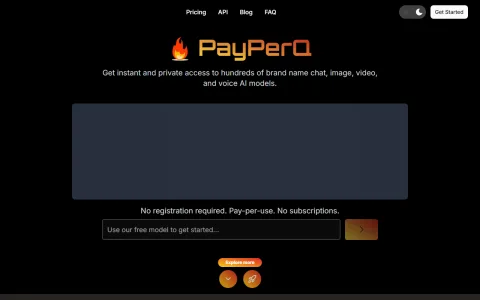
PayPerQ (ppq.ai) is a privacy-oriented AI inference platform launched by Matt Ahlborg that delivers pay-per-prompt access to hundreds of brand-name generative models. As of 2026-05-30, the service operates through three interfaces: a browser-based web app, an OpenAI-compatible API, and PPQ Whisper, a desktop voice-dictation application. Users can generate text, images, video, and audio without creating accounts or providing personal information.
The platform aggregates models from OpenAI (GPT-5.3 through GPT-5.5), Anthropic (Claude Haiku 4.5 through Opus 4.8), Google (Gemini 3 Flash Preview), xAI (Grok 4.20), Mistral, and others. Pricing is usage-based with no subscriptions; the average web app query costs approximately 1.5 cents and typical monthly spending runs around $4.
PayPerQ implements a strong no-KYC model. The homepage explicitly states "No registration required" and "No signup required." Users receive a credit ID upon payment that is stored locally in browser history; no email, phone number, or government ID is requested for standard usage. The service has been listed in privacy directories including Monerica and KYCnot.me with consistent zero-KYC classifications.
The FAQ confirms that lost credit IDs can be recovered from payment records or browser history, reinforcing that no persistent identity linkage is required. API keys are generated without identity verification. This represents a genuine KYC-free experience rather than the "soft KYC" threshold models seen at some competitors.
Privacy claims are substantiated by several concrete features. Conversations in the web app are stored locally on the user's device by default. In May 2026, PayPerQ introduced passkey-encrypted chats with end-to-end encryption, allowing cross-device sync while cryptographically preventing server access to conversation content.
A March 2026 launch added Private (TEE) Models running inside Trusted Execution Environments, where prompts are encrypted in the browser before transmission. The platform also offers an "Online Mode" and standard API endpoints for users with different threat models. No privacy-related breaches or logging incidents appear in the evidence base.
The operator remains anonymous per third-party listings, with self-funded operations and no disclosed jurisdiction or corporate structure.
PayPerQ accepts cryptocurrency including Monero (XMR), Bitcoin (BTC), and Lightning Network (LN) payments. Gift cards are sold through Bitrefill.com and redeemable on-site. The pricing page lists per-token rates with model-specific input and output costs; for example, GPT-5.4 Nano costs $0.21 per million input tokens and $1.31 per million output tokens, yielding approximately 1,250 prompts per dollar.
Minimum top-ups appear flexible-the homepage mentions topping up "as little as 10 cents." API usage is billed against the same prepaid balance. No subscription tiers, monthly minimums, or fiat payment requirements exist for core functionality. The average API query cost is roughly 2 cents.
The web app requires no download and works across devices. A Progressive Web App is available for mobile users. Model switching between GPT-5, Claude, Gemini, DeepSeek, and others occurs through a single click. The API integrates with popular tools including Claude Code, Cline, OpenWebUI, Roo, Cursor, and Goose via standard OpenAI-compatible endpoints.
Support channels include a chat widget and Telegram community. Third-party reviews are sparse but mixed: aitools.xyz shows a 3.00/5 rating from six user reviews, while privacy-focused reviewers express enthusiasm. No widespread outage reports or accessibility complaints surfaced in the evidence.
PayPerQ suits privacy-conscious users, Monero holders, and developers seeking flexible AI access without subscription lock-in. The pay-per-use model benefits infrequent users who would overpay for flat-rate services. Developers building AI agents or coding assistants gain multi-model access through familiar OpenAI-compatible tooling. Users requiring guaranteed uptime, enterprise SLAs, or regulated data handling should evaluate alternatives, as the anonymous operator structure offers no corporate accountability.
Pseudonymous access, no personal data.
PayPerQ collects no identity data for standard usage and stores conversations locally by default, with optional end-to-end encrypted sync and TEE-based inference available. The operator is anonymous with no disclosed jurisdiction; users should verify current privacy practices independently before depositing significant funds.
No
Custodial
No
Requires email
No
Logs IP
Verdict
PayPerQ is a leading option for privacy-focused users who prioritize anonymity over institutional backing. It outperforms mainstream AI subscriptions on KYC avoidance and undercuts them for intermittent usage, but the anonymous operator structure and thin review ecosystem demand careful fund management and realistic trust expectations.
This review is monitored and refreshed regularly.
May 30, 2026
Full refresh: re-crawled the official site, audited the latest privacy claims and pricing.
May 28, 2026
Added Private TEE models and passkey-encrypted chats to privacy features.
May 28, 2026
Updated model list to include GPT-5.5, Claude Opus 4.8, Gemini 3 Flash, Grok 4.20.
May 15, 2026
Confirmed gift card availability via Bitrefill and PWA mobile support.
May 22, 2025
Initial review published.
7 user reviews
moneromaxi
Finally an AI service that takes XMR without asking for my life story. Topped up $10, been using it for weeks. The E2EE chat sync is a nice addition.
anon_trader
API works perfectly with Claude Code. Swapping between GPT and Claude models without multiple subscriptions saves money. Wish there was more transparency about who's behind it.
privacyfirst
Local storage by default, optional TEE models, no email required. This is how AI should work. Average spend is under $5 a month for my usage.
xmr_only
Works well when it works, but had a credit ID get cleared once and support was slow through the chat widget. Recovering from payment record was possible but annoying.
sat_stacker
Lightning payments are instant. The 10 cent minimum top-up is great for testing. Model selection is better than most competitors at this price point.
cypher_punk
Anonymous operator means zero recourse if they disappear. I keep minimal balance and treat it as experimental. The tech is solid but trust is hard.
dev_null
Integrated with OpenWebUI in minutes. Image generation and editing through the API is smooth. Documentation could be deeper but examples cover the basics.