
























 Featured
8.0
Independent & unsponsored · No ads, no tracking · verified every 6 hours
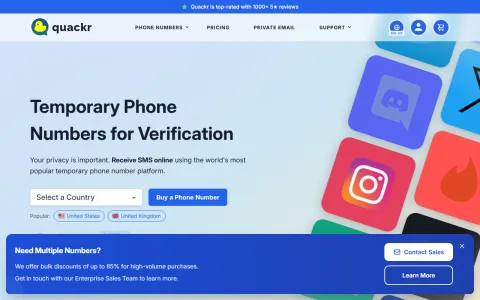
Quackr is a temporary phone number platform founded in 2020 and operated by Quackr Limited, a company registered in Hong Kong. The service provides two tiers: free public temporary numbers shared across users, and paid private rentals with exclusive access. As of 2026-05-30, Quackr claims more than 2 million users and 1 million monthly active users, with coverage across 30+ countries including the United States, United Kingdom, Australia, Germany, France, India, Russia, and Brazil.
The platform markets itself as privacy-focused, offering SMS verification for apps like WhatsApp, Telegram, Instagram, Google, and PayPal. Paid numbers are advertised as "non-VoIP" with guaranteed delivery or refund, while free numbers are publicly accessible and rotated monthly.
Quackr's KYC stance is mixed and context-dependent. The free temporary numbers require no registration or identity verification-users can simply visit the site and view incoming SMS messages publicly. This is genuinely no-KYC for basic usage.
However, paid services introduce friction. The official site states payment options include "card, PayPal, or crypto" for private numbers. A significant red flag surfaced in third-party evidence: a user on Privacy Guides reported being KYC'd when adding a bank account for payment, with subsequent BTC refund refusal. This suggests that while crypto payments may remain KYC-free, traditional financial rails trigger identity verification. The older kycnot.me metadata classified Quackr as "Rare KYC," which appears consistent with this bifurcated model-free usage is anonymous, but paid transactions through certain channels are not.
The terms of service (effective October 21, 2025) include a "Legitimate Funds & Financial Compliance" section requiring users to warrant that funds are legally obtained, indicating regulatory awareness that could prompt verification triggers.
Quackr's privacy posture contains notable contradictions. The platform claims "Privacy-First" principles and states it "never sell[s] your data or compromise[s] your information." However, multiple independent reviews identify critical risks.
The most severe concern: free number SMS messages are publicly visible without authentication. Anyone can view verification codes sent to shared numbers, creating immediate account hijacking risk. Third-party review site receive-sms.com characterized this as "public message exposure" with "no encryption for messages" and "no message privacy protection."
The privacy policy reveals additional complexity. It is issued by "Publisher First, Inc. dba Quackr," a different corporate entity than the Hong Kong-registered Quackr Limited mentioned in terms of service. The policy covers "Publisher Websites" with third-party advertising integrations, suggesting data collection for ad targeting. Cookie usage is disclosed, including "Functional Cookies" for tracking.
For paid users, numbers are supposedly private and exclusive. The API (available only to 6-month and 12-month rental customers) uses JSON calls with API key authentication, which is standard but not exceptional.
Quackr's pricing structure is tiered but not fully transparent in the crawled evidence. Free numbers carry no monetary cost but have functional limitations-shared access, public visibility, and rapid burnout from overuse.
Paid private numbers offer durations of 1 week, 1 month, 6 months, and 12 months. The 6-month and 12-month tiers include API access. Pricing varies by country; the United States is shown as a selectable option with the aforementioned duration tiers, but specific dollar amounts were truncated in the crawl data.
Payment methods explicitly listed: card, PayPal, and cryptocurrency. The crypto option is the primary no-KYC pathway, though the specific cryptocurrencies accepted are not detailed in the official crawl beyond generic "crypto" references. The older kycnot.me tags included Monero, Bitcoin, and Lightning-users should verify current acceptance before purchase.
Enterprise and bulk options exist with discounts up to 85% for high-volume purchases, per the blog page. A refund guarantee is advertised for paid numbers that fail verification.
Quackr's interface is web-based with no mandatory app download, though an Android app "Quackr: Travel eSIM & Numbers" exists with minimal adoption (approximately 1,100 monthly downloads as of recent data, no ratings). The platform emphasizes "instant activation" and 99.9% uptime claims.
User feedback is polarized. Trustpilot shows approximately 1,330 reviews with a 4-star overall rating-respectable but not exceptional. Positive reviews cite ease of use and reliability for paid numbers. Negative feedback, including from Reddit users, highlights that free numbers "never work because the numbers have already been used." One blackhatworld.com review noted free numbers "get burned very quickly due to the high demand."
Support options include email and help documentation. The help guide acknowledges common failure modes: VPN detection by target platforms, device emulator blocking, and Google specifically flagging repeated attempts. Notably, Quackr offers free Google account creation assistance when users hit verification walls-sending them desired credentials to create accounts on users' behalf.
Quackr suits two distinct user profiles with different risk tolerances. For casual, low-stakes verification needs, free numbers provide immediate, zero-cost, no-KYC access-acceptable if the user understands that messages are public and numbers are heavily reused. This is suitable for testing, non-sensitive registrations, or situations where account security is irrelevant.
Privacy-conscious users seeking reliable, exclusive number access must use paid tiers, ideally via cryptocurrency to minimize KYC exposure. The platform is practical for WhatsApp, Telegram, and similar app verifications where "non-VoIP" numbers reduce blocking rates compared to typical virtual numbers.
Quackr is not appropriate for high-security use cases requiring message confidentiality, nor for users expecting consistent free-tier reliability. Competitors offering genuinely private free tiers or stronger encryption may better serve strict privacy requirements.
KYC only above certain thresholds.
Quackr's privacy model is split: free usage requires no identity data but exposes all messages publicly. Paid usage through bank or PayPal may trigger KYC per user complaints, while crypto payments appear to avoid this. The privacy policy references third-party advertising cookies and data transfers, suggesting broader data practices than the marketing implies.
No
Custodial
No
Requires email
No
Logs IP
Verdict
Quackr works best for users needing quick, disposable SMS verification who can accept the tradeoffs: free for casual anonymous use with public exposure, or paid with crypto for better privacy and reliability. It outperforms typical free SMS services on paid tier quality but falls short of dedicated privacy-first alternatives for sensitive communications.
This review is monitored and refreshed regularly.
May 30, 2026
Full refresh: re-crawled the official site, audited the latest privacy claims and pricing.
August 19, 2025
Added eSIM and travel services per new app listing and site navigation updates.
July 3, 2025
Updated KYC assessment: incorporated user report of bank-payment KYC trigger and BTC refund dispute.
March 6, 2025
Revised free-tier privacy warning: confirmed public SMS exposure remains unaddressed in current site design.
January 2, 2025
Initial review published.
5 user reviews
moneromaxi
paid number worked for whatsapp verification first try. used xmr, no id asked. free numbers are useless though, everything flagged.
burner_account_7
free tier is a privacy nightmare. my telegram code was visible to anyone who checked that number. stick to paid if you use this.
privacyfirst
decent coverage and instant activation, but the kycnot.me 'rare kyc' tag seems accurate. had to switch to crypto after paypal asked for docs.
sms_hunter
api is solid for automation with 12-month rental. json webhooks reliable, uptime good for my use case.
anon_trader
terrible experience. paid with bank transfer, got kyc'd, support refused btc refund. terms hide this until you're already committed.