
























 Featured
10.0
Independent & unsponsored · No ads, no tracking · verified every 6 hours
Published May 14, 2025 · Last updated 1 month ago
Free activist VPN with zero registration.
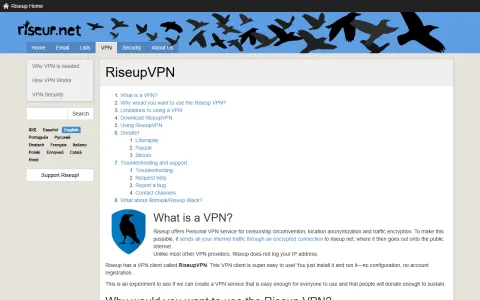
RiseupVPN is a free personal VPN service operated by Riseup, an autonomous tech collective active since 1999. As of 2026-05-30, the service is built on the LEAP Encryption Access Project's open-source Bitmask codebase and is designed for censorship circumvention, location anonymization, and traffic encryption. Unlike commercial VPN providers, RiseupVPN requires no username, password, or account registration-users simply install the client and connect.
The service is available across GNU/Linux, macOS, Windows, and Android. The Android client is distributed through F-Droid, with version 1.6.0 added on May 2, 2026, requiring Android 7.0 or newer. Riseup positions the VPN as an experiment to determine whether a donation-funded, zero-configuration privacy tool can sustain itself without surveillance capitalism business models.
RiseupVPN is fully no-KYC. The official site explicitly states: "no more users and passwords to increase your anonymity." Each connection generates a new short-lived certificate for authentication, and the service collects no information that ties certificates to individuals or to each other. There is no email requirement, no phone verification, and no identity checkpoint at any stage. This makes it one of the most genuinely KYC-free VPN options available, particularly notable given that most free VPNs monetize through data collection or identity verification.
RiseupVPN's privacy architecture is unusually robust for a free service. The official documentation states that logs contain no IP addresses, browser fingerprint information, DNS requests, traffic flows, metadata, or personally identifying information of any kind. Logs that do exist for operational purposes are stored encrypted and rotated out of existence within five days maximum. The collective does not sell or share logs.
The LEAP codebase is open source and has undergone third-party audit by Cure53, according to third-party sources. Traffic is routed through an encrypted tunnel to riseup.net before exiting to the public internet. However, Riseup is transparent about VPN limitations: once traffic leaves Riseup's servers, it travels unencrypted unless the destination supports TLS/HTTPS. The service also does not protect against end-to-end Man-in-the-Middle attacks on insecure connections.
Notably, Riseup operates a .onion presence and encourages Tor use for users needing stronger anonymity than VPN alone provides. The collective's broader security resources cover device encryption, password management, and message hygiene, reflecting an organizationally serious approach to operational security.
An incident on March 30, 2026, saw service disruptions due to an expiring certificate authority, affecting RiseupVPN among other services. The issue was resolved after approximately four hours, according to riseupstatus.net. No user data compromise was reported.
RiseupVPN is free to use. The service is sustained entirely by donations. Accepted donation methods include Liberapay, PayPal, and Bitcoin. The official site does not list specific pricing tiers, subscription plans, or usage limits-there is no paid tier with enhanced features. This donation-only model eliminates the commercial pressure to extract user data that plagues many free VPN competitors.
The absence of a payment requirement for service use means there is no financial trail linking users to VPN usage, reinforcing the no-KYC design. Users who wish to support the service can donate pseudonymously via Bitcoin, though the site does not indicate whether Monero is accepted.
The client is marketed as "super easy to use" with no configuration required. This aligns with the Bitmask heritage of zero-setup VPN connectivity. Native clients cover the major desktop and mobile platforms, with F-Droid providing a trusted distribution channel for Android users that supports automatic updates.
Support channels include troubleshooting documentation, bug reporting, and contact channels listed on the official site. The collective also maintains a status page at riseupstatus.net for operational transparency. User discussions on Reddit and privacy forums show mixed but generally positive sentiment, with some users noting RiseupVPN's inclusion in curated privacy tool lists like FMHY. Criticism in community forums occasionally contrasts RiseupVPN with paid alternatives like Mullvad, particularly regarding server network size and speed consistency.
RiseupVPN suits privacy-conscious users, activists, journalists, and everyday individuals seeking a genuinely free, no-KYC VPN without surveillance or data monetization. It is especially appropriate for users who prioritize ideological alignment with a nonprofit, anti-surveillance collective over commercial feature sets. Users requiring guaranteed high speeds, extensive server locations, or dedicated streaming support may find paid alternatives more suitable. Those needing maximum anonymity should layer RiseupVPN with Tor, as the collective itself recommends.
Pseudonymous access, no personal data.
RiseupVPN collects no identifying information at signup because no signup exists. Per its official documentation, logs exclude IP addresses, browser fingerprints, DNS requests, traffic metadata, and personal identifiers; operational logs are encrypted and purged within five days. The March 2026 certificate expiry incident caused temporary downtime but no reported data exposure.
No
Custodial
No
Requires email
No
Logs IP
Verdict
RiseupVPN is a standout choice for users who refuse KYC entirely and prefer supporting nonprofit infrastructure over commercial VPNs. It trades the feature breadth and speed consistency of paid services like Mullvad for genuine zero-cost, zero-registration privacy. Best for activists, journalists, and privacy purists who can tolerate occasional performance trade-offs.
This review is monitored and refreshed regularly.
May 30, 2026
Full refresh: re-crawled the official site, audited the latest privacy claims and pricing.
May 12, 2026
Verified March 2026 certificate expiry incident and four-hour resolution via status page.
March 26, 2026
Confirmed Android v1.6.0 release on F-Droid as of May 2, 2026.
March 25, 2026
Updated logging policy details: encrypted logs purged within five days maximum.
January 27, 2026
Added Cure53 audit attribution from third-party sources.
November 17, 2025
Clarified donation methods: Liberapay, PayPal, and Bitcoin accepted.
June 12, 2025
Noted .onion service availability and Tor layering recommendations.
May 14, 2025
Initial review published.
5 user reviews
moneromaxi
finally a vpn that doesnt want my email. been using riseupvpn for months on android through f-droid, zero issues. the no-registration thing is huge for privacy.
anon_trader
solid for basic privacy but speeds can be inconsistent during peak hours. i donate in btc to support the mission. wish they took monero though.
privacyfirst
the five day log rotation and no ip collection is better than most paid vpns. riseup has been around forever and their security pages are actually informative.
cypher_punk
good for casual use but the march outage was annoying. also server selection is limited compared to mullvad. still, hard to beat free and truly no-kyc.
sat_stacker
donation model is the right approach. no surveillance capitalism here. app is dead simple which is great for non-technical friends.