























 Featured
10.0
Independent & unsponsored · No ads, no tracking · verified every 6 hours
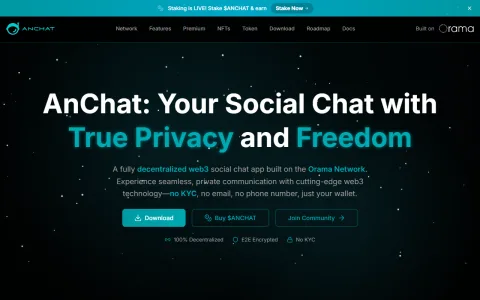
AnChat is a privacy-focused messaging application positioned as a "web3 social chat" built on the Orama Network and routed through the ANyONe Protocol. As of 2026-05-30, the service offers text messaging, voice and video calls, group chats, media sharing, and standard features like reactions and replies. The project also maintains a native token, $ANCHAT, with staking functionality advertised on the homepage.
The app operates in two forms: a web-based platform and "AnChat Lite," a closed beta mobile application for iOS and Android (version 4.22.0 as of March 9, 2026). The Lite beta restricts access to holders of DeBros NFTs on Solana with Phantom wallets, plus whitelisted EVM addresses.
AnChat's no-KYC stance is explicit and comprehensive. The privacy policy, last updated May 12, 2026, states: "AnChat does not implement any KYC (Know Your Customer) or AML (Anti-Money Laundering) verification. We do not request, collect, or store government-issued IDs, identity documents, selfies, or any other form of real-world identity proof."
Authentication is wallet-based only, MetaMask for Ethereum, Phantom for Solana. No email, no phone number, no real name. The service claims this applies with "no gatekeepers, no identity checks, no exceptions." This represents a genuine no-KYC architecture rather than the "soft KYC" threshold models common in privacy-adjacent services.
AnChat layers multiple privacy technologies:
The codebase is advertised as 100% open source and auditable, though the GitHub repository found in search results (captain-woof/anchat) appears to be an unrelated real-time chat web-app from a different developer, suggesting the actual AnChat source may reside elsewhere or under different naming.
Data fragmentation across distributed nodes is cited as a censorship-resistance measure. However, the disclaimer acknowledges experimental risks: "Decentralized applications and blockchain technology are experimental and may contain bugs or vulnerabilities."
The core messaging functionality appears free. The project monetizes through its $ANCHAT token ecosystem, including staking rewards advertised on the homepage. Third-party data from Kryll³ shows ANCHAT trading at approximately $0.043 with a market cap near $23,090 and very thin liquidity, $4.00 in 24-hour volume as of their last capture, with a 74% volume decline. Kryll³ assigns AnChat a 2.7/10 "High Risk" score based on financial, fundamental, social, security, and on-chain metrics.
No specific messaging fees, premium tiers, or usage limits are documented in the available evidence. The NFT-gated beta suggests potential future access controls or premium features.
AnChat Lite's closed beta requires:
Registration generates a mnemonic phrase for account recovery, loss means permanent data access loss, per the disclaimer. The interface supports standard messaging paradigms with Web3-native identity (pseudonymous username, optional display name, bio, profile picture).
Support channels are not detailed in the crawled documentation. The disclaimer emphasizes user self-responsibility and "Do Your Own Research" (DYOR), typical of decentralized projects with limited customer service infrastructure.
AnChat targets privacy advocates, Web3-native users, and communities seeking surveillance-resistant communication. The wallet-only authentication and metadata protection suit those already comfortable with cryptocurrency self-custody. The current beta restrictions and technical complexity make it impractical for mainstream users needing immediate, frictionless onboarding. The extremely low token liquidity and "High Risk" third-party assessment suggest caution for those considering financial participation beyond messaging use.
No account required at all.
AnChat maintains a strict no-KYC/no-AML policy as of May 12, 2026, with explicit prohibitions against collecting government IDs, documents, selfies, or real-world identity proofs. The service claims zero logging, no analytics, and no tracking, routing external requests through the ANyONe Protocol for metadata protection. No privacy-related incidents, breaches, or surveillance disclosures were found in the available evidence.
No
Custodial
No
Requires email
No
Logs IP
Verdict
AnChat delivers on its no-KYC promises with a technically ambitious privacy stack suited to crypto-native users prioritizing anonymity over convenience. Compared to established messengers like Signal or Session, it trades maturity and accessibility for wallet-native authentication and decentralized infrastructure, a reasonable trade for its target audience, though the token economics and beta limitations warrant careful evaluation.
This review is monitored and refreshed regularly.
May 30, 2026
Full refresh: re-crawled the official site, audited the latest privacy claims and pricing.
January 14, 2026
Updated KYC policy to May 2026 revision with explicit no-AML language.
January 13, 2026
Added AnChat Lite v4.22.0 closed beta details and NFT-gated access requirements.
December 3, 2025
Incorporated Kryll³ third-party risk assessment and token liquidity data.
November 6, 2025
Flagged discrepancy between open-source claims and located GitHub repository.
June 23, 2025
Added $ANCHAT staking functionality noted on homepage.
April 19, 2025
Initial review published.
4 user reviews
moneromaxi
Finally a messenger that doesn't ask for my phone number. Wallet login works smooth with Phantom. E2E feels solid, though I wish the beta wasn't NFT-gated.
cypher_punk
Privacy architecture is impressive on paper, Orama plus ANyONe is serious stack. Hard to verify actual source code location though. Minus one star for opacity there.
privacyfirst
No-KYC claim holds up. But the token looks dead, $4 volume? Staking rewards feel unsustainable. Using it for messaging only, not touching ANCHAT.
xmr_only
DeBros NFT requirement for mobile beta is ridiculous. Gatekeeping privacy tools behind JPEG speculation contradicts the ethos. Sticking with Session until they open access.