




















 Featured
9.0
Independent & unsponsored · No ads, no tracking · verified every 6 hours
Published December 17, 2024 · Last updated 1 month ago
KYC-free Monero crowdfunding for everyone.
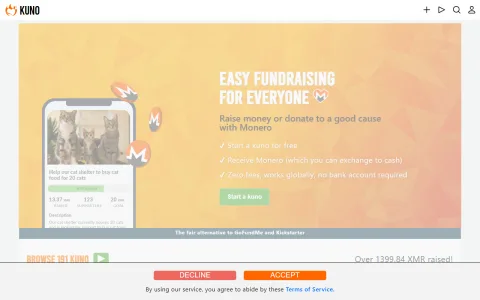
Kuno is a non-custodial, peer-to-peer crowdfunding platform operated by Anne Media and built specifically for the Monero community. Positioned as a privacy-respecting alternative to GoFundMe and Kickstarter, it allows individuals and projects to raise funds exclusively in Monero (XMR) without requiring identity documents, bank accounts, or financial intermediaries. As of 2026-05-30, the platform hosts 192 active campaigns and has facilitated over 1,400 XMR in total donations across causes ranging from humanitarian aid and media projects to software development and small business ventures.
The platform is open-source, with its codebase available on Codeberg under the handle nebras/kuno. The repository describes it as "amateur-level, messy and not fully tested," signaling that contributors should expect rough edges rather than enterprise-grade polish. Kuno operates on both clearnet and Tor, with an onion address published in its footer.
Kuno's no-KYC stance is explicit and absolute. The FAQ states: "Kuno will always be 100% KYC-free, and will never require government ID in order to start a fundraiser or send a donation." This is not merely a policy preference but a structural feature-funds flow directly from donor to recipient via Monero addresses, with Kuno acting only as a listing and discovery layer.
Campaign creation requires only a title, description, goal amount, Monero address, and optional secret view key for progress tracking. No email verification is mandatory, though an email field exists for password recovery and donation notifications. Pseudonymous fundraising is explicitly supported, with the FAQ confirming it is possible to "raise money under a pseudonym." The platform's architecture makes KYC technically impossible to implement retroactively, as there is no custody of funds or centralized financial plumbing.
Kuno's privacy model inherits from Monero's protocol-level protections. Transactions are private-by-default, shielding sender, recipient, and amount data from blockchain analysis. The platform itself collects minimal data: campaign details, an optional email, and a password hash for editing access. No government ID, banking information, or geolocation data is requested.
The site offers a Tor onion service (kuno7d2jlfa4twyztna4czphx4lxj3i7g64t477beuwnggb22tyxnuyd.onion) for users seeking additional network-layer privacy. However, the codebase's self-described "amateur-level" status and lack of formal security auditing warrant caution. Campaigns rely on self-reported goals and progress; there is no escrow, dispute resolution, or refund mechanism. The "Campaign Contract" users agree to is essentially an honor-code pledge about honest use of funds, with no technical enforcement.
Kuno charges zero platform fees for basic use. Donors send XMR directly to campaign addresses; the platform never touches funds. This eliminates chargeback risk, frozen account risk, and the typical 5-10% fee structures of mainstream crowdfunding platforms.
Recipients can convert XMR to cash through P2P markets like LocalMonero, Bisq, or crypto ATMs (per Kuno's FAQ guidance), or spend directly via merchant directories like Monerica. The platform suggests Cake Wallet, Feather Wallet, Monerujo, and Stack Wallet as compatible wallets. There are no stated minimum or maximum campaign limits, though the interface enforces a 1,500-character minimum for campaign proposals.
The interface is sparse and functional. Campaign creation follows a four-step wizard: details, proposal, goal/address, and password. Discovery relies on basic search and featured placement, with 192 campaigns browsable as of this crawl. The platform supports 13 language localizations including Arabic, Esperanto, Swahili, and Yoruba-unusually broad for a niche crypto tool.
Support channels appear limited to an Anne Forum board and FAQ documentation. The "Knowledge Base" provides guidance on acquiring Monero, wallet selection, and exchange rates, but no live chat or ticket system is evident. Campaign editing requires a self-managed password; lost passwords mean lost edit access. The platform's "BOOST" feature appears to allow promoted placement, though specific mechanics are not detailed in the crawl.
Kuno serves three overlapping constituencies: privacy activists and cypherpunks seeking funding without surveillance; individuals in underbanked or sanctioned regions lacking access to traditional financial rails; and the broader Monero community funding ecosystem projects like Revuo Monero, Copa Monero, and circular-economy initiatives. The Gaza Humanitarian Fundraiser (203.45 XMR raised, 162 supporters) and Argentina circular economy campaign illustrate both the platform's global reach and its concentration in Monero-specific advocacy.
It is not suitable for those needing fiat-denominated fundraising, buyer protection, or institutional credibility. The lack of escrow, auditing, and formal dispute resolution means trust rests entirely on campaign creators and community reputation.
No account required at all.
Kuno enforces a 100% KYC-free policy by design, never collecting government ID or banking data. The platform stores only campaign metadata and optional email addresses, with password-based edit access. Monero's privacy-by-default transactions shield donor and recipient blockchain activity. No privacy incidents, breaches, or logging controversies were found in the evidence as of 2026-05-30.
No
Custodial
No
Requires email
No
Logs IP
Verdict
Kuno suits privacy-purists, Monero advocates, and the unbanked who prioritize anonymity over consumer protections. Compared to mainstream crowdfunding, it trades safeguards for sovereignty; compared to CCS or Monero Forum Funding System, it offers lower barriers to entry but less community vetting.
This review is monitored and refreshed regularly.
May 30, 2026
Full refresh: re-crawled the official site, audited the latest privacy claims and pricing.
May 28, 2026
Verified 192 active campaigns and 1,400+ XMR total raised across platform.
March 10, 2026
Confirmed Tor onion service still published in site footer with updated address.
October 9, 2025
Updated language support count to 13 localizations including Arabic and Yoruba.
January 5, 2025
Noted open-source repository status unchanged, still self-described as amateur-level.
December 17, 2024
Initial review published.
4 user reviews
moneromaxi
Used Kuno to fund a local privacy workshop. Zero friction, no ID nonsense, funds hit my Cake Wallet directly. Exactly what crowdfunding should be.
anon_trader
Great concept and clean no-KYC policy, but the interface is barebones and I worry about scam campaigns with no escrow. Vet who you donate to.
privacyfirst
The Tor onion address is a huge plus. Created a campaign from a high-risk region without issues. Language support is surprisingly broad too.
xmr_skeptic
Codebase admits it's amateur and untested. That gives me pause for long-term reliability. Works fine for small donations though.