
























 Featured
10.0
Independent & unsponsored · No ads, no tracking · verified every 6 hours
Published May 6, 2025 · Last updated 1 month ago
Decentralized VPN with privacy coin payments.
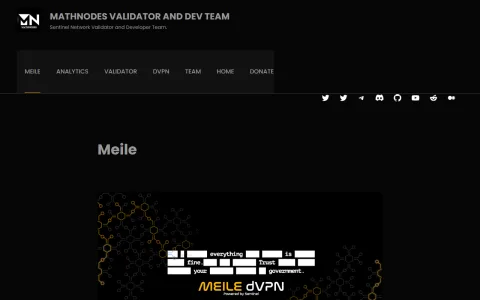
Meile dVPN is a desktop decentralized VPN client developed by MathNodes, a validator and developer team active in the Cosmos ecosystem since 2022. The application connects users to community-hosted nodes on the Sentinel network, a Layer 1 blockchain for peer-to-peer bandwidth. As of 2026-05-30, the official website has migrated from meile.app to mathnodes.com/index.php/meile-dvpn-client-linux-os-x/, reflecting an organizational shift under the MathNodes brand.
The service emphasizes "unstoppable privacy" through decentralization: nodes run from datacenters, universities, and residential locations with no single point of failure. Meile supports Windows, macOS, and multiple Linux distributions including Ubuntu, Debian, Fedora, and Arch, with version 2.6.0 currently in beta featuring UX/UI improvements and animations.
Meile dVPN operates without identity verification. The privacy policy covers only website interactions (comment IP addresses, browser agents, cookies) and explicitly states no KYC requirements for VPN usage. Payment occurs entirely through cryptocurrency wallets integrated into the application, eliminating traditional financial identity linkage. The MathNodes team has published multiple articles criticizing age verification and KYC mandates as "draconian measures" that sideline user privacy.
The 2026 refresh confirms continued no-KYC operation. Users need only download the client and possess cryptocurrency for node subscriptions or plan payments. No email, phone number, or government ID is requested at any stage of service access.
Meile implements several privacy-enhancing technologies beyond basic VPN encryption:
The MathNodes privacy policy discloses standard web analytics collection but makes no logging claims for VPN traffic itself. The decentralized architecture means no single entity controls all nodes, though users must trust individual node operators within the Sentinel ecosystem.
Meile offers two subscription tiers:
Payment methods have expanded significantly:
The "Fees, Burns, & Buybacks" section on the pricing page suggests token economics involvement, though specific fee percentages are not detailed in available evidence. Subscription plans are distinct from direct node payments, which use hourly or per-GB consumption models with DVPN/ATOM.
Installation occurs through direct download or APT repository for Debian/Ubuntu systems (curl -fsSL https://apt.mathnodes.com/install.sh | sudo bash). Version 2.5.4 brought substantial updates including auto-filtering of plan nodes, in-app update notifications, and streamlined payment flows.
The beta v2.6.0 indicates active development with animation and interface improvements. Community support channels include Telegram, Discord, Twitter/X, GitHub, Reddit, and Medium. MathNodes operates as a transparent developer team with public validator infrastructure and published contribution bounties.
Linux users benefit from native package management; Windows and macOS users download binaries directly. ARM architecture support is available for select distributions.
Meile dVPN suits privacy-focused users comfortable with cryptocurrency transactions and desktop applications. The no-KYC design, Monero integration, and Ring Sessions specifically appeal to anonymity-maximizing audiences. Technical users benefit from V2Ray protocol support and mobile connection sharing capabilities.
The service fits those seeking alternatives to centralized VPNs with mandatory email registration and credit card payments. However, the cryptocurrency-only payment structure and desktop-only clients (no native mobile app) create friction for mainstream users. The Sentinel ecosystem dependency means users must navigate blockchain-specific concepts like gas fees and token swaps.
Meile dVPN delivers genuine no-KYC privacy infrastructure with innovative blockchain-native features like Ring Sessions. The MathNodes team's validator credibility and transparent development provide reasonable trust assurances. Best suited for cryptocurrency-native privacy advocates; less appropriate for casual users wanting one-click mobile VPN solutions.
Pseudonymous access, no personal data.
Meile dVPN maintains a strict no-KYC stance with no identity verification for VPN usage. The privacy policy only covers website visitor data (IP addresses for spam detection, cookies for login convenience) not VPN traffic. Ring Sessions generate decoy blockchain transactions to reduce metadata linkability. No logging claims for VPN sessions are made, though decentralized node operators fall outside MathNodes' direct control.
No
Custodial
No
Requires email
No
Logs IP
Verdict
Meile dVPN serves privacy-maximizing cryptocurrency users seeking genuinely no-KYC VPN access with advanced anonymity features. The Ring Sessions innovation and broad privacy coin support distinguish it from centralized competitors, though the desktop-only, crypto-native design limits mainstream adoption.
This review is monitored and refreshed regularly.
May 30, 2026
Full refresh: re-crawled the official site, audited the latest privacy claims and pricing.
April 30, 2026
Domain migrated from meile.app to mathnodes.com; v2.6.0 beta now live with UI improvements.
April 29, 2026
Ring Sessions enabled by default in v2.5.4; decoy transaction privacy now automatic for plan subscribers.
February 4, 2026
Expanded payment options added: Zano, fUSD, ZEPH/ZSD, and shielded ZEC via BTCPay Server integration.
December 29, 2025
Mobile connection sharing launched via QR codes and V2RayNG companion app in v2.5.3.
December 25, 2025
APT repository established for Debian/Ubuntu command-line installation and updates.
November 9, 2025
Firo InstantLock spark payments integrated for faster private transactions.
May 6, 2025
Initial review published.
4 user reviews
moneromaxi
Ring Sessions finally make blockchain-based VPNs actually private. The XMR payment flow is seamless in-app. Been using since v2.4 and the UX keeps improving.
dvpn_curious
Solid tech but the mobile setup is clunky. Need V2RayNG plus QR scanning every time. Great for desktop privacy, not daily carry.
sentinel_staker
MathNodes has been a reliable validator for years. Their client is the smoothest way to use Sentinel dVPN. 300+ crypto options is overkill but appreciated.
privacyfirst
Decent concept but worried about node operator trust. No audit of whether random nodes log traffic. Ring Sessions help on-chain privacy, not endpoint privacy.