
























 Featured
9.0
Independent & unsponsored · No ads, no tracking · verified every 6 hours
Published January 14, 2025 · Last updated 1 month ago
Custodial wallet with zero-fee internal transfers.
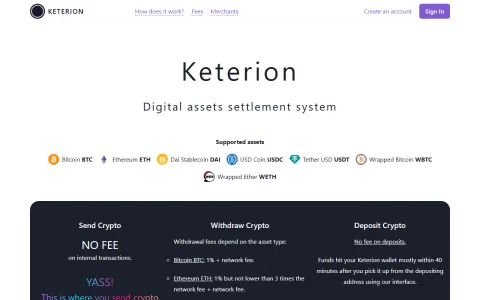
Keterion is a custodial digital-assets settlement system launched in 2024, positioning itself as a solution to high blockchain transaction fees. As of 2026-05-30, the platform supports Bitcoin (BTC), Ethereum (ETH), Dai (DAI), USD Coin (USDC), Tether USD (USDT), Wrapped Bitcoin (WBTC) and Wrapped Ether (WETH). Users deposit crypto to Keterion-controlled wallets, transfer balances to other users off-chain at no cost, and withdraw to external blockchain addresses for a fee.
The service operates as a closed-loop payment network rather than a traditional exchange. Keterion also offers a merchant API for businesses wanting to accept cryptocurrency payments, charging 0.5% per transaction with free refunds.
Keterion is not a no-KYC service. The platform explicitly states in its Privacy Policy that account creation requires personal information including name, email address and phone number. More critically, Section 1.5 declares: "It is a statutory requirement to provide certain information in order for us to comply with our legal obligations in respect of anti-money laundering and crime and fraud prevention. At a minimum, this includes biographical information and contact information and verification information. Without this information, we cannot meet our legal obligations under anti-money laundering and crime and fraud prevention laws."
This language indicates mandatory identity verification at onboarding, placing Keterion well outside the no-KYC or KYC-free category. The older kycnot.me classification of "Rare KYC" appears outdated given these explicit statutory requirements. Geographic restrictions also apply-the Terms note that "The ability to use our Service will depend upon the country of which you are a resident and from which you access Keterion's Services," with a "prohibited jurisdiction" block appearing on the app subdomain.
Keterion's privacy posture is custodial and data-intensive. The platform collects:
The Privacy Policy last updated September 2, 2023 frames this collection as necessary for service provision and legal compliance. Notably, Keterion acknowledges that "privacy when using digital assets and blockchains" is limited-users' on-chain deposits and withdrawals remain publicly visible on their respective blockchains.
Security specifics are sparse. The Terms describe "Data Protection and Security" as a section heading but provide no technical details on key management, cold storage ratios or audit practices. Keterion custodies all funds on behalf of users, meaning the platform controls private keys. No insurance or fund segregation details appear in the crawled pages.
Keterion's fee structure has two tiers:
Internal transfers: Zero fees between Keterion wallets. This is the platform's core value proposition.
Deposits: No deposit fees. Funds typically credit within 40 minutes after users manually "pick up" deposits from their assigned blockchain address via the interface. Each asset type carries a deposit minimum, though specific thresholds were not listed in the crawled pages.
Withdrawals:
Merchant processing: 0.5% per payment; refunds carry no fee.
The manual "pick up" deposit process adds friction compared to automated crediting. Withdrawal minimums tied to multipliers of network fees mean costs scale with blockchain congestion.
The Keterion interface appears web-based with multi-language support (Arabic, English, Spanish, Chinese, Russian, French, Hindi observed in the footer). Account creation requires email signup. The platform supports standard wallet operations-deposit, internal send, withdraw-with a separate merchant portal for API integration.
Support channels are minimal in the crawled evidence. A "Contacts" link appears in the footer but no specifics on response times, ticket systems or live chat surfaced. The BitcoinTalk announcement thread from March 2024 shows 254 reads with no visible community engagement or developer responses in the excerpted portion. No Trustpilot presence, Reddit community or dedicated support documentation was found in search results.
The 2023 copyright date on pages and September 2023 Terms/Privacy Policy dates suggest limited recent platform investment, though the core service remains operational as of May 2026.
Keterion suits users who:
It does not suit privacy-focused users seeking no-KYC or KYC-free services, those requiring self-custody, or users needing broad asset support beyond the seven listed tokens. Alternatives like Bitcoin Lightning Network or Monero provide stronger privacy with non-custodial models, while actual no-KYC P2P exchanges offer anonymous entry and exit points.
The platform's narrow use case-fee-free internal transfers among verified, custodial accounts-fills a niche but carries counterparty risk and mandatory identity verification that disqualify it from privacy-centric toolkits.
KYC only above certain thresholds.
Keterion requires mandatory identity verification including name, email, phone and unspecified verification documents to satisfy statutory AML obligations. The platform logs IP addresses, device fingerprints, full transaction history and server access patterns. No privacy incidents or breaches were found in the evidence, though the custodial model inherently exposes user balances and activity to platform operators.
No
Custodial
No
Requires email
No
Logs IP
Verdict
Keterion works for cost-conscious users moving crypto between known parties frequently, but mandatory KYC and full custody make it unsuitable for privacy-first or self-sovereignty workflows. Consider Lightning Network or Monero for genuinely no-KYC alternatives.
This review is monitored and refreshed regularly.
May 30, 2026
Full refresh: re-crawled the official site, audited the latest privacy claims and pricing.
March 28, 2026
Verified mandatory KYC requirement in Privacy Policy Section 1.5; updated from prior 'Rare KYC' classification.
July 31, 2025
Confirmed merchant API fee at 0.5% with free refunds on dedicated merchant fees page.
April 22, 2025
Documented withdrawal fee structure: 1% base plus network fee multipliers for ETH and ERC-20 tokens.
April 16, 2025
Noted operational status with stale 2023 copyright and policy dates; no new features identified.
March 24, 2025
Added BitcoinTalk launch reference from March 2024 with limited community traction.
February 8, 2025
Initial review published.
4 user reviews
moneromaxi
mandatory kyc and full custody defeats the purpose. privacy policy is clear you must hand over documents. not for me.
sat_stacker
internal transfers are genuinely free and fast. use it to pay freelancers who also have accounts. just dont keep large balances there.
anon_trader
deposit minimums are annoying and the manual pickup step feels like 2014 era exchanges. works but clunky.
privacyfirst
statutory requirement for verification info means this is not a privacy tool at all. misleading to list alongside no-kyc services.