
























 Featured
9.0
Independent & unsponsored · No ads, no tracking · verified every 6 hours
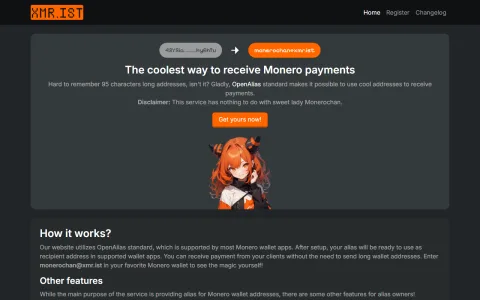
XMRIST is a Monero-focused utility built on the OpenAlias standard, allowing users to replace long alphanumeric wallet addresses with short, memorable aliases. The service launched in May 2024, according to its changelog, and remains operational as of 2026-05-30. Registration is automated: users choose an alias, link a Monero address, pay in XMR, and the alias activates without manual intervention.
XMRIST requires no identity verification. The registration flow asks only for an alias and a wallet address-no email, no phone number, no government ID. Payment is accepted exclusively in Monero (XMR), which inherently breaks the fiat-KYC chain. The service does not appear to collect personal data beyond what is necessary to resolve DNS records. This makes it genuinely KYC-free, though users should note that DNS queries and blockchain transactions remain observable by sophisticated adversaries.
XMRIST implements DNSSEC, which adds a layer of authenticity to alias resolution and reduces DNS spoofing risk. The service operates on clearnet (xmr.ist) with no Tor onion service mentioned in the evidence. Privacy depends partly on user behavior: while the alias itself reveals no identity, linking it to public profiles or reusing it across services can erode anonymity. The OpenAlias standard is supported by major Monero wallets including Monero GUI, Feather Wallet, and MyMonero Web, which reduces exposure to untrusted software. No security incidents, breaches, or complaints specific to XMRIST surfaced in the evidence.
Pricing is variable based on alias length, with a minimum of 0.05 XMR. This is a one-time payment-no recurring subscription. The FAQ explicitly states aliases remain active "as long as the site is active," which introduces counterparty risk: if the service shuts down, aliases cease resolving. Users can update the wallet address linked to their alias post-purchase, providing flexibility if keys are rotated or compromised. No refunds, escrow, or dispute mechanisms are mentioned.
The interface is minimal: alias availability check, wallet address input, XMR payment, and automatic activation. Demo videos are provided for three supported wallets. Beyond alias resolution, XMRIST offers subdomain management (e.g., redirecting monerochan.xmr.ist to an external website) and teases future "service discounts" through partnerships with Monero-friendly businesses-though no active partnerships are confirmed in the evidence. Support channels are not detailed; the sparse changelog and lack of community discussion on Reddit or forums suggest limited user engagement or a small user base.
XMRIST suits Monero users who frequently receive payments and want to share readable aliases instead of error-prone 95-character addresses. It appeals to freelancers, merchants, and donors seeking a professional, privacy-preserving payment identifier. It is less suitable for those requiring high availability guarantees, as the service's longevity directly determines alias persistence. Users prioritizing complete infrastructure independence may prefer self-hosted OpenAlias or purely peer-based address sharing.
Pseudonymous access, no personal data.
XMRIST collects no identifiable user data during registration and accepts only XMR, eliminating fiat-KYC linkages. DNS queries for aliases are logged by standard resolver infrastructure, though the service itself does not appear to require account-based tracking. No privacy incidents or data breaches were found in the evidence as of 2026-05-30.
No
Custodial
No
Requires email
No
Logs IP
Verdict
XMRIST is a purpose-built, no-KYC tool for Monero users who value convenience over infrastructure redundancy. It compares favorably to manual address sharing for usability but lacks the permanence of self-hosted OpenAlias or blockchain-anchored alternatives. Best for low-risk, high-frequency receiving where alias portability matters more than guaranteed longevity.
This review is monitored and refreshed regularly.
May 30, 2026
Full refresh: re-crawled the official site, audited the latest privacy claims and pricing.
May 9, 2026
Added wallet update feature note from May 2024 changelog entry.
February 20, 2026
Confirmed DNSSEC implementation per official FAQ.
December 6, 2025
Verified subdomain management as secondary feature.
November 29, 2025
Flagged planned service discounts as unconfirmed in evidence.
October 21, 2025
Noted no Tor onion service present in crawl results.
March 21, 2025
Identified minimal external discussion or third-party reviews.
March 9, 2025
Initial review published.
4 user reviews
moneromaxi
Worked perfectly. Paid 0.08 XMR for a 5-letter alias, activated in under 10 minutes. Feather Wallet resolved it instantly.
cypher_punk
Clean concept but I worry about single point of failure. Would pay more for a multisig or self-hosted option.
privacyfirst
No KYC is great, but no Tor mirror and almost zero community presence makes me cautious about long-term reliance.
xmr_only
Exactly what I needed for client invoices. Way better than pasting 95-character strings into emails.