

























January 10, 2020: the day European custodial Bitcoin became KYC by default
How the EU's Fifth Anti-Money Laundering Directive transposition deadline rewrote the European custodial crypto market in three months, what it covered, what it deliberately did not, and the trajectory to MiCA.
The Editors
Editorial desk
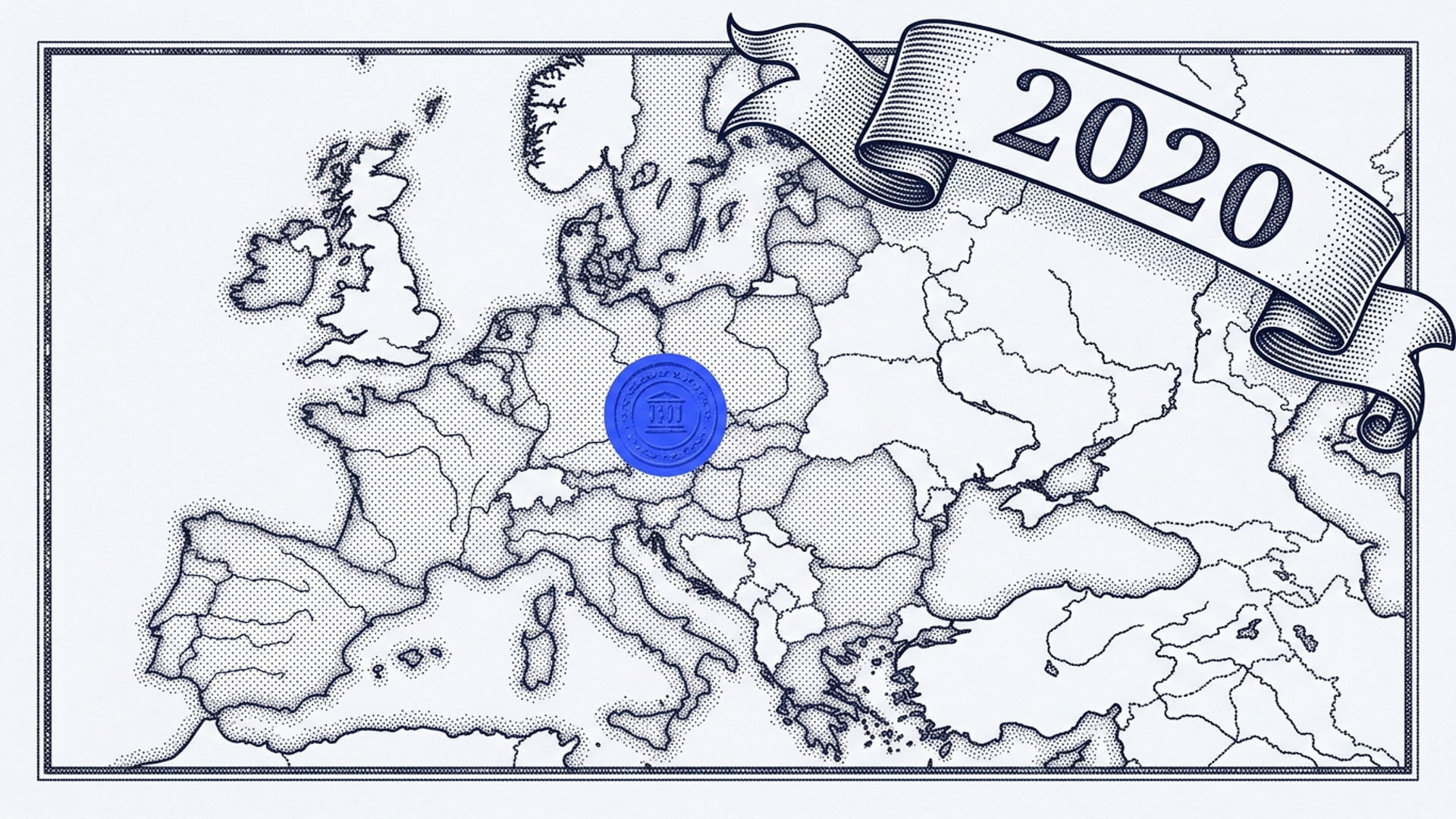
January 10, 2020: the day European custodial Bitcoin became KYC by default
Most regulatory deadlines pass unnoticed. The one set by Directive (EU) 2018/843, the Fifth Anti-Money Laundering Directive, did not. By the morning of January 10, 2020, every member state of the European Union was supposed to have transposed 5AMLD into national law, and the practical effect was that virtual currency exchange platforms and custodian wallet providers operating in Europe could no longer treat customer identification as a discretionary product decision. It had become a statutory obligation, enforced by national financial intelligence units, with the same architecture of customer due diligence that already governed banks and notaries. For anyone who had been buying Bitcoin on a European custodial venue under a pseudonym, an email address, or a phone number alone, the window closed that week. The directive that closed it had been signed eighteen months earlier and had been hiding in plain sight in the Official Journal since June 19, 2018.
What 5AMLD actually said
The text published as Directive (EU) 2018/843 amended the existing Fourth Anti-Money Laundering Directive rather than replacing it, and the operative change for the crypto industry sat in two small places. Article 1(2)(d) inserted a definition of virtual currency into EU law for the first time, in language that was deliberately broad and technology-neutral: "a digital representation of value that is not issued or guaranteed by a central bank or a public authority, is not necessarily attached to a legally established currency and does not possess a legal status of currency or money, but is accepted by natural or legal persons as a means of exchange and which can be transferred, stored and traded electronically." Article 2 then extended the directive's list of obliged entities to include "providers engaged in exchange services between virtual currencies and fiat currencies" and "custodian wallet providers", which was the first time any EU-level instrument named those categories of business and brought them inside the AML perimeter.
Inside the perimeter, the obligations were not new, but they were now binding on a sector that had largely operated without them. Covered firms had to perform, at minimum, four duties on every business relationship:
- Customer due diligence, meaning identification and verification of the customer before opening an account or processing certain transactions
- Identification of the beneficial owner where the customer was a legal entity, traced through ownership chains to a natural person
- Submission of suspicious transaction reports to the national financial intelligence unit whenever activity warranted it
- Retention of customer records and transaction data for at least five years after the end of the business relationship
None of those duties were exotic in 2018. Banks had lived with them for decades. The novelty was that a Berlin-based Bitcoin brokerage with twelve employees and a Stuttgart custodial wallet startup now had the same paperwork burden as a private bank, with no transitional regime worth speaking of.
What it did not cover
The boundaries of 5AMLD mattered as much as its content. The directive reached custodial exchanges and custodial wallets, which meant entities that held customer assets on behalf of the customer. It did not reach peer-to-peer trading conducted directly between individuals, it did not reach self-hosted wallets where the user controlled the keys, and it did not reach the early decentralised finance protocols that were just beginning to circulate liquidity through smart contracts. That negative space, drawn by the directive's own definitions, was where the no-KYC market migrated. The directive's drafters appear to have understood the gap and chose not to close it in 2018, partly because the technical mechanism for closing it was not yet clear and partly because the political economy of the file required a narrower text to pass within the Juncker Commission's term. The Sixth Anti-Money Laundering Directive, Directive (EU) 2018/1673, followed in late 2018 with formal transposition by December 2020, but its purpose was to harmonise criminal liability for money laundering across member states rather than to widen the scope of who counted as an obliged entity. The architectural decision to leave peer-to-peer commerce and self-custody outside AML scope therefore survived 5AMLD intact, and lived on through the early years of MiCA drafting.
The transposition rollout
National implementations diverged in tone more than in substance. Germany was among the first to act, with the Gesetz zur Umsetzung der Änderungsrichtlinie zur Vierten EU-Geldwäscherichtlinie taking effect on January 1, 2020, nine days before the EU deadline, and BaFin acquiring jurisdiction over crypto custody as a regulated financial service under the Kreditwesengesetz. France transposed in June 2020 through the PACTE law machinery and the PSAN regime administered by the AMF, which folded 5AMLD obligations into a registration framework that already existed for digital asset service providers. The Netherlands took a more aggressive interpretive line, with De Nederlandsche Bank imposing a registration regime that several exchanges, including Bittrex and later Binance, found onerous enough to either restrict service or withdraw from the market entirely. The United Kingdom, still inside the transposition window before its formal departure from the European Union, brought the directive into domestic law through amendments to the Money Laundering Regulations 2017, with the Financial Conduct Authority taking on the registration role from January 2020. The result was a continent that had agreed on the floor of regulation while disagreeing about the ceiling, and the ceiling varied enough to shape where firms decided to incorporate.
What changed for users
The user-side timeline became visible across late 2019 and the first quarter of 2020. Coinbase's German subsidiary tightened its identification tiers ahead of the BaFin licensing process it would eventually complete in 2021. Bitstamp introduced longer onboarding questionnaires and source-of-funds prompts on higher-tier accounts through 2019 and into the spring of 2020. Kraken's European entity progressively narrowed the cases in which users could fund accounts or trade without verified identity, until verified KYC became the default funnel. Smaller venues either invested in compliance stacks, sold themselves to compliant competitors, or geofenced European users. By the end of the first quarter of 2020 the practical answer to the question "where in Europe can a retail user buy Bitcoin from a regulated venue without showing identification" had shifted from "several places" to "essentially nowhere", and that shift was the direct visible product of the directive that had taken effect three months earlier.
From 5AMLD to MiCA
The four-step trajectory is now clear in retrospect. 5AMLD defined who was inside the AML perimeter. 6AMLD harmonised the criminal consequences of laundering across the member states. The recast Transfer of Funds Regulation, adopted in 2023 and operative from December 30, 2024, imposed the Travel Rule on crypto-asset transfers, requiring originator and beneficiary information to accompany transactions above thresholds and, in some cases, regardless of threshold for transfers to and from self-hosted wallets. The Markets in Crypto-Assets Regulation, applicable in phases through 2024 with full effect from December 30, 2024, then layered a complete licensing regime on top, with prudential, conduct, and disclosure obligations that look much closer to the MiFID architecture than to anything the 2018 drafters of 5AMLD had in mind. Each step tightened a different screw, and the cumulative effect by the end of 2024 was a European custodial crypto market regulated more thickly than any other major jurisdiction.
What this changes for the Directory
For the no-KYC directory the lineage is direct. The reason this catalogue exists in the shape it does, with categories for peer-to-peer marketplaces, for atomic swap interfaces, for Tor-routed exchange services, for self-custody-only brokers, and for jurisdictionally diverse remittance bridges, is that the boundary drawn by Article 2 of 5AMLD in 2018 created a commercial niche on the unregulated side of the line. Bisq's user growth through 2020, the late-life persistence of LocalBitcoins until its 2023 shutdown, the steady traffic into Hodl Hodl and Robosats, and the appearance of dedicated no-KYC swap services were all market responses to the same regulatory event. The directive that was supposed to integrate crypto into the European AML framework also, by its own scope limits, mapped out the territory that remained outside it. This site catalogues that territory.
Sources
- Directive (EU) 2018/843, EUR-Lex CELEX 32018L0843
- CoinDesk, Europe's New AML Rules Bring Crypto Into the Fold (Jan 10, 2020)
- CMS Law-Now, 5AMLD and virtual currencies (Jan 2020)
- Sumsub, 5AMLD Explained
- Elliptic, The 5th Anti-Money Laundering Directive
Edit log
- 2023-08-15 : First draft assembled from the EUR-Lex text and the CoinDesk January 2020 retrospective, structural outline locked at seven sections.
- 2023-09-04 : Added the Germany, France, and Netherlands transposition case studies after cross-checking national gazette dates against the CMS Law-Now briefing.
- 2023-09-18 : Verbatim Article 1(2)(d) definition of virtual currency restored to its full quoted form following a fact-check pass against the consolidated EUR-Lex version.
- 2023-09-26 : Expanded the MiCA and Transfer of Funds Regulation paragraph with the December 30, 2024 application dates after the Regulation (EU) 2023/1114 timeline was confirmed.
- 2023-10-02 : Final pass for cadence and house style, em-dashes removed throughout, internal link to the directory's peer-to-peer category inserted in the closing section.
Browse the directory
Find a no-KYC service for what you need.
More articles
 Investigation
A wallet that does not collect identity, paired with a Swiss IBAN that legally cannot exist without it
OffChain just announced a Swiss IBAN linked to its no-KYC mesh wallet, EUR/CHF/USD conversion on demand, a debit card, and SEPA/SWIFT in both directions, all of it "fully offline". We walk through the four ways this can actually work, and the one Swiss law makes hardest.
Read article Regulation
The comment window closes at midnight, and every US-licensed stablecoin issuer is now on the clock
FinCEN and OFAC's joint proposed rule on Permitted Payment Stablecoin Issuers under the GENIUS Act closes its public comment docket today, June 9 2026. Five obligations, USDC and PYUSD in scope, and what it means for self-custody on-ramps.
Read article Profile
The story that changed when the honeypots leaked
A 2026 working threat model for an investigative reporter covering crypto cybercrime, after the IDMerit, Sumsub, and Chen Zhi cases reshaped what an organized criminal adversary can buy. Tools, walkthrough, twenty-four hours over her shoulder.
Read article